Bridge component that converts the outgoing CAN packets into gridconnect format and enqueues them into the DirectHub for sending. More...
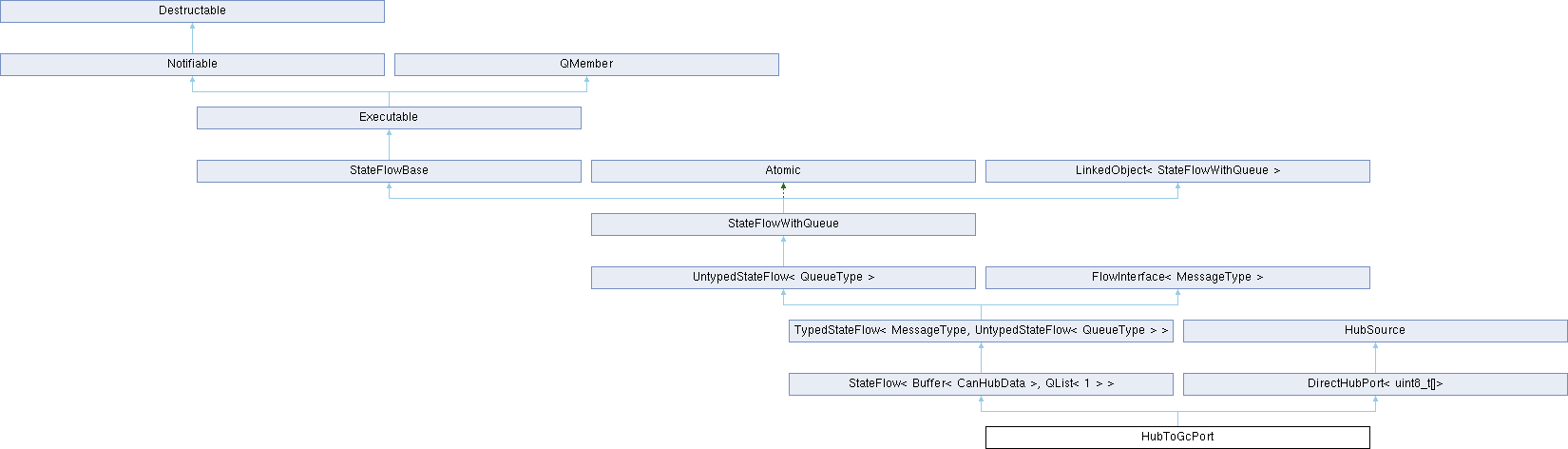
Public Member Functions | |
| HubToGcPort (DirectHubInterface< uint8_t[]> *gc_hub, CanHubFlow *can_hub) | |
| Action | entry () override |
| Handles the next CAN packet that we need to send. | |
| Action | do_send () |
| Handles the callback from the direct hub when it is ready for us to send the message. | |
| void | send (MessageAccessor< uint8_t[]> *msg) override |
| GC to binary path. | |
 Public Member Functions inherited from StateFlow< MessageType, QueueType > Public Member Functions inherited from StateFlow< MessageType, QueueType > | |
| StateFlow (Service *service) | |
| Constructor. | |
| Public Member Functions inherited from TypedStateFlow< MessageType, UntypedStateFlow< QueueType > > | |
| TypedStateFlow (Service *service) | |
| Constructor. | |
| virtual | ~TypedStateFlow () |
| Destructor. | |
| void | send (MessageType *msg, unsigned priority=UINT_MAX) OVERRIDE |
| Sends a message to the state flow for processing. | |
| Public Member Functions inherited from UntypedStateFlow< QueueType > | |
| UntypedStateFlow (Service *service) | |
| Constructor. | |
| Public Member Functions inherited from StateFlowWithQueue | |
| void | notify () override |
| Wakeup call arrived. Schedules *this on the executor. | |
| bool | is_waiting () |
| Public Member Functions inherited from StateFlowBase | |
| void | run () override |
| Callback from the executor. | |
| Service * | service () |
| Return a pointer to the service I am bound to. | |
| Public Member Functions inherited from Executable | |
| void | test_deletion () |
| Public Member Functions inherited from QMember | |
| void | init () |
| Initiailize a QMember, in place of a public placement construction. | |
| Public Member Functions inherited from LinkedObject< StateFlowWithQueue > | |
| StateFlowWithQueue * | link_next () |
| Public Member Functions inherited from FlowInterface< MessageType > | |
| virtual Pool * | pool () |
| virtual MessageType * | type_helper () |
| This function is never user in the code, but GDB can use it to infer the correct message types. | |
| MessageType * | alloc () |
| Synchronously allocates a message buffer from the pool of this flow. | |
| void | alloc_async (Executable *target) |
| Asynchronously allocates a message buffer from the pool of this flow. | |
| Public Member Functions inherited from DirectHubPort< uint8_t[]> | |
| virtual void | send (MessageAccessor< uint8_t > *msg)=0 |
| Send some data out on this port. | |
Private Attributes | |
| LinkedDataBufferPtr | buf_ |
| Output buffer of gridconnect bytes that will be sent to the GC DirectHub. | |
| DirectHubInterface< uint8_t[]> * | targetHub_ |
| Where to send the target data. | |
| BarrierNotifiable * | pktDone_ = nullptr |
| Done notifiable from the source packet. | |
| CanHubFlow * | sourceHub_ |
| Hub where we get the input data from (registered). | |
| HubSource * | me_ |
| The source pointer we need to use for sending messages to the target hub. | |
| bool | inlineRun_: 1 |
| True while we are calling the target hub send method. | |
| bool | inlineComplete_: 1 |
| True if the send completed inline. | |
| uint16_t | packetSize_ |
| Number of bytes this gridconnect packet is. | |
Static Private Attributes | |
| static constexpr unsigned | MIN_GC_FREE = 29 |
| Minimum amount of free bytes in the current send buffer in order to use it for gridconnect rendering. | |
Additional Inherited Members | |
| Public Types inherited from TypedStateFlow< MessageType, UntypedStateFlow< QueueType > > | |
| typedef Base::Action | Action |
| Allows using Action without having StateFlowBase:: prefix in front of it. | |
| Public Types inherited from FlowInterface< MessageType > | |
| typedef MessageType | message_type |
| Stores the message template type for external reference. | |
| Static Public Member Functions inherited from StateFlowBase | |
| template<class T , typename... Args> | |
| static void | invoke_subflow_and_ignore_result (FlowInterface< Buffer< T > > *target_flow, Args &&... args) |
| Calls a helper flow to perform some actions. | |
| Static Public Member Functions inherited from LinkedObject< StateFlowWithQueue > | |
| static StateFlowWithQueue * | link_head () |
| static Atomic * | head_mu () |
| Locks the list for modification (at any entry!). | |
| Static Public Member Functions inherited from FlowInterface< MessageType > | |
| static MessageType * | cast_alloc (QMember *entry) |
| Down casts and initializes an asynchronous allocation result to the appropriate flow's buffer type. | |
| Protected Types inherited from UntypedStateFlow< QueueType > | |
| typedef Action(StateFlowBase::* | Callback) () |
| State Flow callback prototype. | |
| Protected Types inherited from StateFlowBase | |
| typedef Action(StateFlowBase::* | Callback) () |
| State Flow callback prototype. | |
| Protected Member Functions inherited from TypedStateFlow< MessageType, UntypedStateFlow< QueueType > > | |
| void | release () OVERRIDE |
| Unrefs the current buffer. | |
| void | return_buffer () |
| For state flows that are operated using invoke_subflow_and_wait this is a way to hand back the buffer to the caller. | |
| MessageType * | message () |
| MessageType * | transfer_message () |
| Releases ownership of the current message. | |
| Protected Member Functions inherited from UntypedStateFlow< QueueType > | |
| void | send (BufferBase *msg, unsigned priority=UINT_MAX) |
| Sends a message to the state flow for processing. | |
| QMember * | queue_next (unsigned *priority) OVERRIDE |
| Takes the front entry in the queue. | |
| bool | queue_empty () OVERRIDE |
| Action | call_immediately (Callback c) |
| Imediately call the next state upon return. | |
| Protected Member Functions inherited from StateFlowWithQueue | |
| StateFlowWithQueue (Service *service) | |
| Constructor. | |
| Action | exit () |
| Terminates the processing of this flow. | |
| Action | release_and_exit () |
| Terminates the processing of the current message. | |
| BufferBase * | message () |
| BufferBase * | transfer_message () |
| Releases ownership of the current message. | |
| void | reset_message (BufferBase *message, unsigned priority) |
| Sets the current message being processed. | |
| unsigned | priority () |
| void | set_priority (unsigned priority) |
| Overrides the current priority. | |
| void | start_flow_at_init (Callback c) |
| Call this from the constructor of the child class to do some work before the main queue processing loop begins. | |
| Protected Member Functions inherited from StateFlowBase | |
| StateFlowBase (Service *service) | |
| Constructor. | |
| ~StateFlowBase () | |
| Destructor. | |
| void | reset_flow (Callback c) |
| Resets the flow to the specified state. | |
| bool | is_state (Callback c) |
| bool | is_terminated () |
| void | start_flow (Callback c) |
| Resets the flow to the specified state and starts it. | |
| Action | again () |
| Call the current state again via call_immediately. | |
| Action | exit () |
| Terminate current StateFlow activity. | |
| Action | delete_this () |
| Terminates the flow and deletes *this. | |
| Action | set_terminated () |
| Sets the flow to terminated state. | |
| Action | call_immediately (Callback c) |
| Imediately call the next state upon return. | |
| Action | wait () |
| Wait for an asynchronous call. | |
| Action | wait_and_call (Callback c) |
| Wait for resource to become available before proceeding to next state. | |
| template<class T > | |
| Action | allocate_and_call (FlowInterface< Buffer< T > > *target_flow, Callback c, Pool *pool=nullptr) |
| Allocates a buffer from a pool and proceed to the next state when allocation is successful. | |
| Action | allocate_and_call (Callback c, QAsync *queue) |
| Allocates an entry from an asynchronous queue, and transitions to a state once the allocation is complete. | |
| template<class T > | |
| Buffer< T > * | full_allocation_result (FlowInterface< Buffer< T > > *target_flow) |
| Takes the result of the asynchronous allocation without resetting the object. | |
| template<class T > | |
| T * | full_allocation_result (TypedQAsync< T > *queue) |
| Takes the result of the asynchronous allocation without resetting the object. | |
| template<class T > | |
| void | cast_allocation_result (T **member) |
| Takes the result of the asynchronous allocation without resetting the object. | |
| template<class T > | |
| Buffer< T > * | get_allocation_result (FlowInterface< Buffer< T > > *target_flow) |
| Takes the result of the asynchronous allocation. | |
| Action | yield_and_call (Callback c) |
| Place the current flow to the back of the executor, and transition to a new state after we get the CPU again. | |
| Action | yield () |
| Place the current flow to the back of the executor, and re-try the current state after we get the CPU again. | |
| Action | sleep_and_call (::Timer *timer, long long timeout_nsec, Callback c) |
| Suspends execution of this control flow for a specified time. | |
| template<class T , typename... Args> | |
| Action | invoke_subflow_and_wait (FlowInterface< Buffer< T > > *target_flow, Callback c, Args &&... args) |
| Calls a helper flow to perform some actions. | |
| Action | read_repeated (StateFlowSelectHelper *helper, int fd, void *buf, size_t size, Callback c, unsigned priority=Selectable::MAX_PRIO) |
| Blocks until size bytes are read and then invokes the next state. | |
| Action | read_single (StateFlowSelectHelper *helper, int fd, void *buf, size_t size, Callback c, unsigned priority=Selectable::MAX_PRIO) |
| Attempts to read at most size_t bytes, and blocks the caller until at least one byte is read. | |
| Action | read_nonblocking (StateFlowSelectHelper *helper, int fd, void *buf, size_t size, Callback c, unsigned priority=Selectable::MAX_PRIO) |
| Attempts to read at most size bytes, and then invokes the next state, even if only zero bytes are available right now. | |
| Action | read_repeated_with_timeout (StateFlowTimedSelectHelper *helper, long long timeout_nsec, int fd, void *buf, size_t size, Callback c, unsigned priority=Selectable::MAX_PRIO) |
| Blocks until size bytes are read, or a timeout expires. | |
| Action | internal_try_read () |
| Implementation state that gets repeatedly called upon every wakeup and tries to make progress on reading. | |
| Action | write_repeated (StateFlowSelectHelper *helper, int fd, const void *buf, size_t size, Callback c, unsigned priority=Selectable::MAX_PRIO) |
| Writes some data into a file descriptor, repeating the operation as necessary until all bytes are written. | |
| Action | internal_try_write () |
| Implementation state that gets repeatedly called upon every wakeup and tries to make progress on writing. | |
| Protected Member Functions inherited from QMember | |
| QMember () | |
| Constructor. | |
| ~QMember () | |
| Destructor. | |
| Protected Member Functions inherited from Atomic | |
| void | lock () |
| void | unlock () |
| Protected Member Functions inherited from LinkedObject< StateFlowWithQueue > | |
| StateFlowWithQueue * | link_this () |
| LinkedObject () | |
| Constructor. Puts *this on the linked list. | |
| ~LinkedObject () | |
| Constructor. Removes *this from the linked list. | |
| StateFlowWithQueue * | link_next () |
| Static Protected Member Functions inherited from LinkedObject< StateFlowWithQueue > | |
| static StateFlowWithQueue * | link_head () |
| static Atomic * | head_mu () |
| Locks the list for modification (at any entry!). | |
| Protected Attributes inherited from QMember | |
| QMember * | next |
| pointer to the next member in the queue | |
| Protected Attributes inherited from LinkedObject< StateFlowWithQueue > | |
| StateFlowWithQueue * | link_ |
| Linked list pointer. | |
| Static Protected Attributes inherited from LinkedObject< StateFlowWithQueue > | |
| static StateFlowWithQueue * | head_ |
| Beginning of the list. | |
Detailed Description
Bridge component that converts the outgoing CAN packets into gridconnect format and enqueues them into the DirectHub for sending.
Definition at line 43 of file DirectHubLegacy.cxx.
Constructor & Destructor Documentation
◆ HubToGcPort()
|
inline |
Definition at line 46 of file DirectHubLegacy.cxx.
◆ ~HubToGcPort()
|
inline |
Definition at line 55 of file DirectHubLegacy.cxx.
Member Function Documentation
◆ do_send()
|
inline |
Handles the callback from the direct hub when it is ready for us to send the message.
Definition at line 97 of file DirectHubLegacy.cxx.
◆ entry()
|
inlineoverridevirtual |
Handles the next CAN packet that we need to send.
Implements TypedStateFlow< MessageType, UntypedStateFlow< QueueType > >.
Definition at line 62 of file DirectHubLegacy.cxx.
◆ send()
|
inlineoverride |
GC to binary path.
Called by the DirectHub with a text packet or a garbage packet.
- Todo:
- consider if we need to set the priority here.
Definition at line 117 of file DirectHubLegacy.cxx.
Member Data Documentation
◆ buf_
|
private |
Output buffer of gridconnect bytes that will be sent to the GC DirectHub.
Definition at line 161 of file DirectHubLegacy.cxx.
◆ inlineComplete_
|
private |
True if the send completed inline.
Definition at line 174 of file DirectHubLegacy.cxx.
◆ inlineRun_
|
private |
True while we are calling the target hub send method.
Definition at line 172 of file DirectHubLegacy.cxx.
◆ me_
|
private |
The source pointer we need to use for sending messages to the target hub.
Definition at line 170 of file DirectHubLegacy.cxx.
◆ MIN_GC_FREE
|
staticconstexprprivate |
Minimum amount of free bytes in the current send buffer in order to use it for gridconnect rendering.
Definition at line 179 of file DirectHubLegacy.cxx.
◆ packetSize_
|
private |
Number of bytes this gridconnect packet is.
Definition at line 176 of file DirectHubLegacy.cxx.
◆ pktDone_
|
private |
Done notifiable from the source packet.
Definition at line 165 of file DirectHubLegacy.cxx.
◆ sourceHub_
|
private |
Hub where we get the input data from (registered).
Definition at line 167 of file DirectHubLegacy.cxx.
◆ targetHub_
|
private |
Where to send the target data.
Definition at line 163 of file DirectHubLegacy.cxx.
The documentation for this class was generated from the following file: