State flow base class with queue but generic message type. More...
#include <StateFlow.hxx>
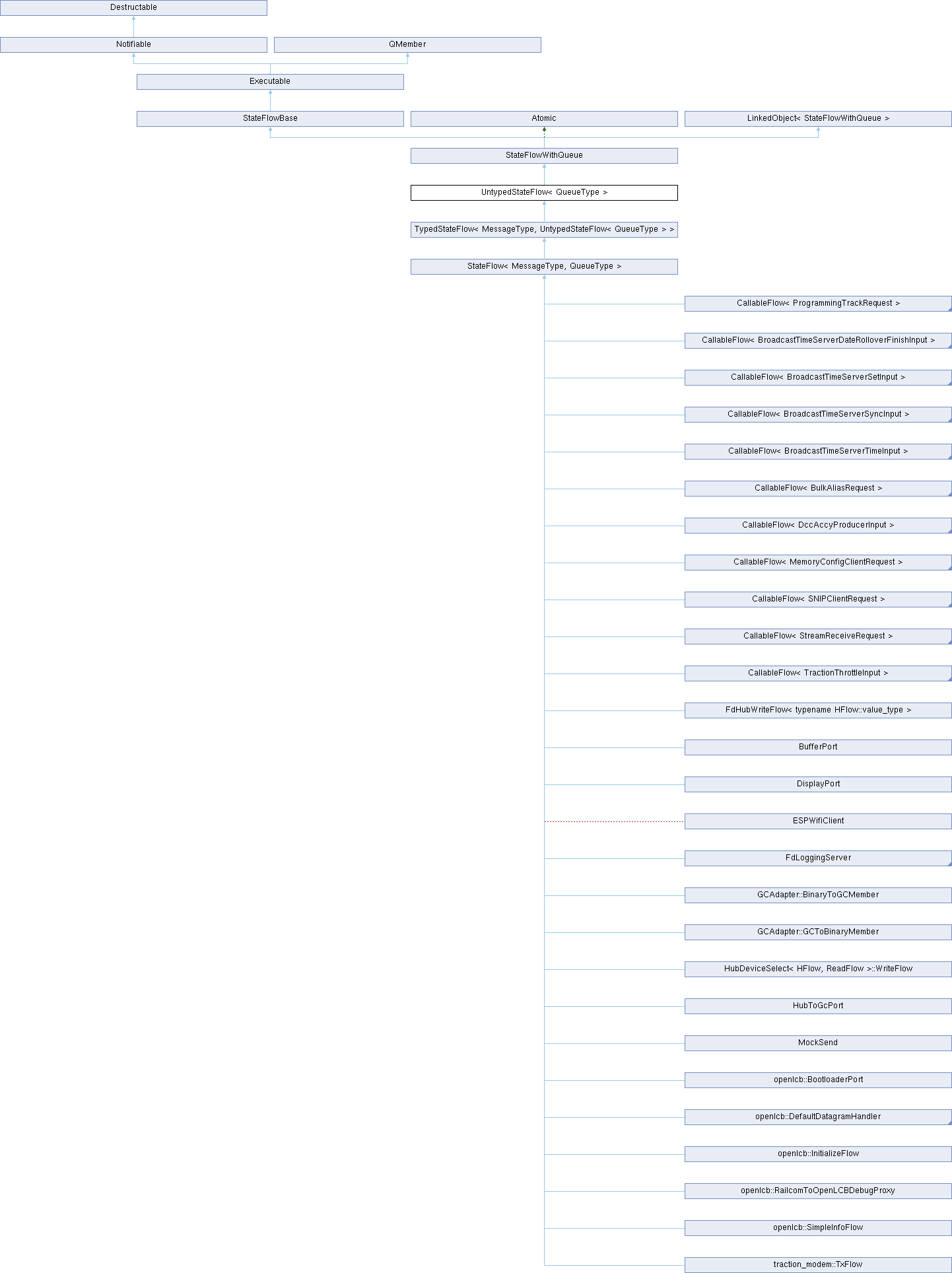
Public Member Functions | |
| UntypedStateFlow (Service *service) | |
| Constructor. | |
 Public Member Functions inherited from StateFlowWithQueue Public Member Functions inherited from StateFlowWithQueue | |
| void | notify () override |
| Wakeup call arrived. Schedules *this on the executor. | |
| bool | is_waiting () |
| Public Member Functions inherited from StateFlowBase | |
| void | run () override |
| Callback from the executor. | |
| Service * | service () |
| Return a pointer to the service I am bound to. | |
| Public Member Functions inherited from Executable | |
| void | test_deletion () |
| Public Member Functions inherited from QMember | |
| void | init () |
| Initiailize a QMember, in place of a public placement construction. | |
| Public Member Functions inherited from LinkedObject< StateFlowWithQueue > | |
| StateFlowWithQueue * | link_next () |
Protected Types | |
| typedef Action(StateFlowBase::* | Callback) () |
| State Flow callback prototype. | |
| Protected Types inherited from StateFlowBase | |
| typedef Action(StateFlowBase::* | Callback) () |
| State Flow callback prototype. | |
Protected Member Functions | |
| void | send (BufferBase *msg, unsigned priority=UINT_MAX) |
| Sends a message to the state flow for processing. | |
| QMember * | queue_next (unsigned *priority) OVERRIDE |
| Takes the front entry in the queue. | |
| bool | queue_empty () OVERRIDE |
| Action | call_immediately (Callback c) |
| Imediately call the next state upon return. | |
| Protected Member Functions inherited from StateFlowWithQueue | |
| StateFlowWithQueue (Service *service) | |
| Constructor. | |
| virtual Action | entry ()=0 |
| Entry into the StateFlow activity. | |
| virtual void | release ()=0 |
| Releases the current message buffer back to the pool it came from. | |
| Action | exit () |
| Terminates the processing of this flow. | |
| Action | release_and_exit () |
| Terminates the processing of the current message. | |
| BufferBase * | message () |
| BufferBase * | transfer_message () |
| Releases ownership of the current message. | |
| void | reset_message (BufferBase *message, unsigned priority) |
| Sets the current message being processed. | |
| unsigned | priority () |
| void | set_priority (unsigned priority) |
| Overrides the current priority. | |
| void | start_flow_at_init (Callback c) |
| Call this from the constructor of the child class to do some work before the main queue processing loop begins. | |
| Protected Member Functions inherited from StateFlowBase | |
| StateFlowBase (Service *service) | |
| Constructor. | |
| ~StateFlowBase () | |
| Destructor. | |
| void | reset_flow (Callback c) |
| Resets the flow to the specified state. | |
| bool | is_state (Callback c) |
| bool | is_terminated () |
| void | start_flow (Callback c) |
| Resets the flow to the specified state and starts it. | |
| Action | again () |
| Call the current state again via call_immediately. | |
| Action | exit () |
| Terminate current StateFlow activity. | |
| Action | delete_this () |
| Terminates the flow and deletes *this. | |
| Action | set_terminated () |
| Sets the flow to terminated state. | |
| Action | call_immediately (Callback c) |
| Imediately call the next state upon return. | |
| Action | wait () |
| Wait for an asynchronous call. | |
| Action | wait_and_call (Callback c) |
| Wait for resource to become available before proceeding to next state. | |
| template<class T > | |
| Action | allocate_and_call (FlowInterface< Buffer< T > > *target_flow, Callback c, Pool *pool=nullptr) |
| Allocates a buffer from a pool and proceed to the next state when allocation is successful. | |
| Action | allocate_and_call (Callback c, QAsync *queue) |
| Allocates an entry from an asynchronous queue, and transitions to a state once the allocation is complete. | |
| template<class T > | |
| Buffer< T > * | full_allocation_result (FlowInterface< Buffer< T > > *target_flow) |
| Takes the result of the asynchronous allocation without resetting the object. | |
| template<class T > | |
| T * | full_allocation_result (TypedQAsync< T > *queue) |
| Takes the result of the asynchronous allocation without resetting the object. | |
| template<class T > | |
| void | cast_allocation_result (T **member) |
| Takes the result of the asynchronous allocation without resetting the object. | |
| template<class T > | |
| Buffer< T > * | get_allocation_result (FlowInterface< Buffer< T > > *target_flow) |
| Takes the result of the asynchronous allocation. | |
| Action | yield_and_call (Callback c) |
| Place the current flow to the back of the executor, and transition to a new state after we get the CPU again. | |
| Action | yield () |
| Place the current flow to the back of the executor, and re-try the current state after we get the CPU again. | |
| Action | sleep_and_call (::Timer *timer, long long timeout_nsec, Callback c) |
| Suspends execution of this control flow for a specified time. | |
| template<class T , typename... Args> | |
| Action | invoke_subflow_and_wait (FlowInterface< Buffer< T > > *target_flow, Callback c, Args &&... args) |
| Calls a helper flow to perform some actions. | |
| Action | read_repeated (StateFlowSelectHelper *helper, int fd, void *buf, size_t size, Callback c, unsigned priority=Selectable::MAX_PRIO) |
| Blocks until size bytes are read and then invokes the next state. | |
| Action | read_single (StateFlowSelectHelper *helper, int fd, void *buf, size_t size, Callback c, unsigned priority=Selectable::MAX_PRIO) |
| Attempts to read at most size_t bytes, and blocks the caller until at least one byte is read. | |
| Action | read_nonblocking (StateFlowSelectHelper *helper, int fd, void *buf, size_t size, Callback c, unsigned priority=Selectable::MAX_PRIO) |
| Attempts to read at most size bytes, and then invokes the next state, even if only zero bytes are available right now. | |
| Action | read_repeated_with_timeout (StateFlowTimedSelectHelper *helper, long long timeout_nsec, int fd, void *buf, size_t size, Callback c, unsigned priority=Selectable::MAX_PRIO) |
| Blocks until size bytes are read, or a timeout expires. | |
| Action | internal_try_read () |
| Implementation state that gets repeatedly called upon every wakeup and tries to make progress on reading. | |
| Action | write_repeated (StateFlowSelectHelper *helper, int fd, const void *buf, size_t size, Callback c, unsigned priority=Selectable::MAX_PRIO) |
| Writes some data into a file descriptor, repeating the operation as necessary until all bytes are written. | |
| Action | internal_try_write () |
| Implementation state that gets repeatedly called upon every wakeup and tries to make progress on writing. | |
| Protected Member Functions inherited from QMember | |
| QMember () | |
| Constructor. | |
| ~QMember () | |
| Destructor. | |
| Protected Member Functions inherited from Atomic | |
| void | lock () |
| void | unlock () |
| Protected Member Functions inherited from LinkedObject< StateFlowWithQueue > | |
| StateFlowWithQueue * | link_this () |
| LinkedObject () | |
| Constructor. Puts *this on the linked list. | |
| ~LinkedObject () | |
| Constructor. Removes *this from the linked list. | |
| StateFlowWithQueue * | link_next () |
Private Attributes | |
| QueueType | queue_ |
| Implementation of the queue. | |
Additional Inherited Members | |
| Static Public Member Functions inherited from StateFlowBase | |
| template<class T , typename... Args> | |
| static void | invoke_subflow_and_ignore_result (FlowInterface< Buffer< T > > *target_flow, Args &&... args) |
| Calls a helper flow to perform some actions. | |
| Static Public Member Functions inherited from LinkedObject< StateFlowWithQueue > | |
| static StateFlowWithQueue * | link_head () |
| static Atomic * | head_mu () |
| Locks the list for modification (at any entry!). | |
| Static Protected Member Functions inherited from LinkedObject< StateFlowWithQueue > | |
| static StateFlowWithQueue * | link_head () |
| static Atomic * | head_mu () |
| Locks the list for modification (at any entry!). | |
| Protected Attributes inherited from QMember | |
| QMember * | next |
| pointer to the next member in the queue | |
| Protected Attributes inherited from LinkedObject< StateFlowWithQueue > | |
| StateFlowWithQueue * | link_ |
| Linked list pointer. | |
| Static Protected Attributes inherited from LinkedObject< StateFlowWithQueue > | |
| static StateFlowWithQueue * | head_ |
| Beginning of the list. | |
Detailed Description
class UntypedStateFlow< QueueType >
State flow base class with queue but generic message type.
This base class contains the function definitions of StateFlow that don't need the actual message type. It's sole purpose is to avoid having to compile these function multiple times for different message type template arguments.
Definition at line 1234 of file StateFlow.hxx.
Member Typedef Documentation
◆ Callback
|
protected |
State Flow callback prototype.
Definition at line 218 of file StateFlow.hxx.
Constructor & Destructor Documentation
◆ UntypedStateFlow()
|
inline |
Constructor.
- Parameters
-
service specifies which thread to execute this state flow on.
Definition at line 1238 of file StateFlow.hxx.
◆ ~UntypedStateFlow()
|
inline |
Definition at line 1240 of file StateFlow.hxx.
Member Function Documentation
◆ call_immediately()
Imediately call the next state upon return.
- Parameters
-
c Callback "state" to move to
- Returns
- function pointer to be returned from state function
Definition at line 318 of file StateFlow.hxx.
◆ queue_empty()
|
inlineprotectedvirtual |
- Returns
- true if this StateFlow does not have any messages pending in the queue.
Implements StateFlowWithQueue.
Definition at line 1284 of file StateFlow.hxx.
◆ queue_next()
|
inlineprotectedvirtual |
Takes the front entry in the queue.
- Returns
- NULL if the queue is empty.
- Parameters
-
priority will be set to the priority of the queue member removed fomr the queue.
Implements StateFlowWithQueue.
Definition at line 1272 of file StateFlow.hxx.
◆ send()
|
inlineprotected |
Sends a message to the state flow for processing.
This function never blocks.
- Parameters
-
msg Message to enqueue priority the priority at which to enqueue this message.
Definition at line 1251 of file StateFlow.hxx.
Member Data Documentation
◆ queue_
|
private |
Implementation of the queue.
Definition at line 1291 of file StateFlow.hxx.
The documentation for this class was generated from the following file: