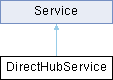
A single service class that is shared between all interconnected DirectHub instances. More...
Public Types | |
| typedef Q | QueueType |
Public Member Functions | |
| DirectHubService (ExecutorBase *e) | |
| Atomic * | lock () |
| void | enqueue_caller (Executable *caller) |
| Adds a caller to the waiting list of who wants to send traffic to the hub. | |
| void | on_done () |
| This function must be called at the end of the enqueued functions in order to properly clear the busy flag or take out the next enqueued executable. | |
 Public Member Functions inherited from Service Public Member Functions inherited from Service | |
| Service (ExecutorBase *e) | |
| Constructor. | |
| ~Service () | |
| Destructor. | |
| ExecutorBase * | executor () |
Public Attributes | |
| unsigned | busy_: 1 |
| 1 if there is any message being processed right now. | |
| QueueType | pendingSend_ |
| List of callers that are waiting for the busy_ lock. | |
Detailed Description
A single service class that is shared between all interconnected DirectHub instances.
It is the responsibility of this Service to perform the locking of the individual flows.
Definition at line 66 of file DirectHub.cxx.
Member Typedef Documentation
◆ QueueType
| typedef Q DirectHubService::QueueType |
Definition at line 69 of file DirectHub.cxx.
Constructor & Destructor Documentation
◆ DirectHubService()
|
inline |
Definition at line 71 of file DirectHub.cxx.
Member Function Documentation
◆ enqueue_caller()
|
inline |
Adds a caller to the waiting list of who wants to send traffic to the hub.
If there is no waiting list, the caller will be executed inline.
- Parameters
-
caller represents an entry point to the hub. It is required that caller finishes its run() by invoking on_done().
- Todo:
- there is a short period of priority inversion here, because we insert an executable into a separate queue here than the Executor. We dequeue the highest priority in on_done(), but if that happens to be a low priority, that might get stuck in the Executor for a long time, even if in the meantime a higher priority message arrives here. A better strategy would be to enqueue the Executable's in the Service's executor directly instead of queueing them and pushing them one by one to the Service's executor. In that case we'd need a third state between busy and not busy: whether we're queueing executable's or whether we're dumping them into the executor. We would also need to keep track of how many went to the Executor already, such that we know when busy_ gets back to false.
Definition at line 87 of file DirectHub.cxx.
◆ lock()
|
inline |
- Returns
- lock object for the busy_ flag.
Definition at line 78 of file DirectHub.cxx.
◆ on_done()
|
inline |
This function must be called at the end of the enqueued functions in order to properly clear the busy flag or take out the next enqueued executable.
Definition at line 118 of file DirectHub.cxx.
Member Data Documentation
◆ busy_
| unsigned DirectHubService::busy_ |
1 if there is any message being processed right now.
Definition at line 136 of file DirectHub.cxx.
◆ pendingSend_
| QueueType DirectHubService::pendingSend_ |
List of callers that are waiting for the busy_ lock.
Definition at line 138 of file DirectHub.cxx.
The documentation for this class was generated from the following file: